Systems beat memory

Systemized vs people-dependent operations

Same market. Same long hours. Different habits around visibility, consistency, staff execution, and continuity. Below is the plain-language map — everything maps to organized information, structured processes, and systems.

Side-by-side personas

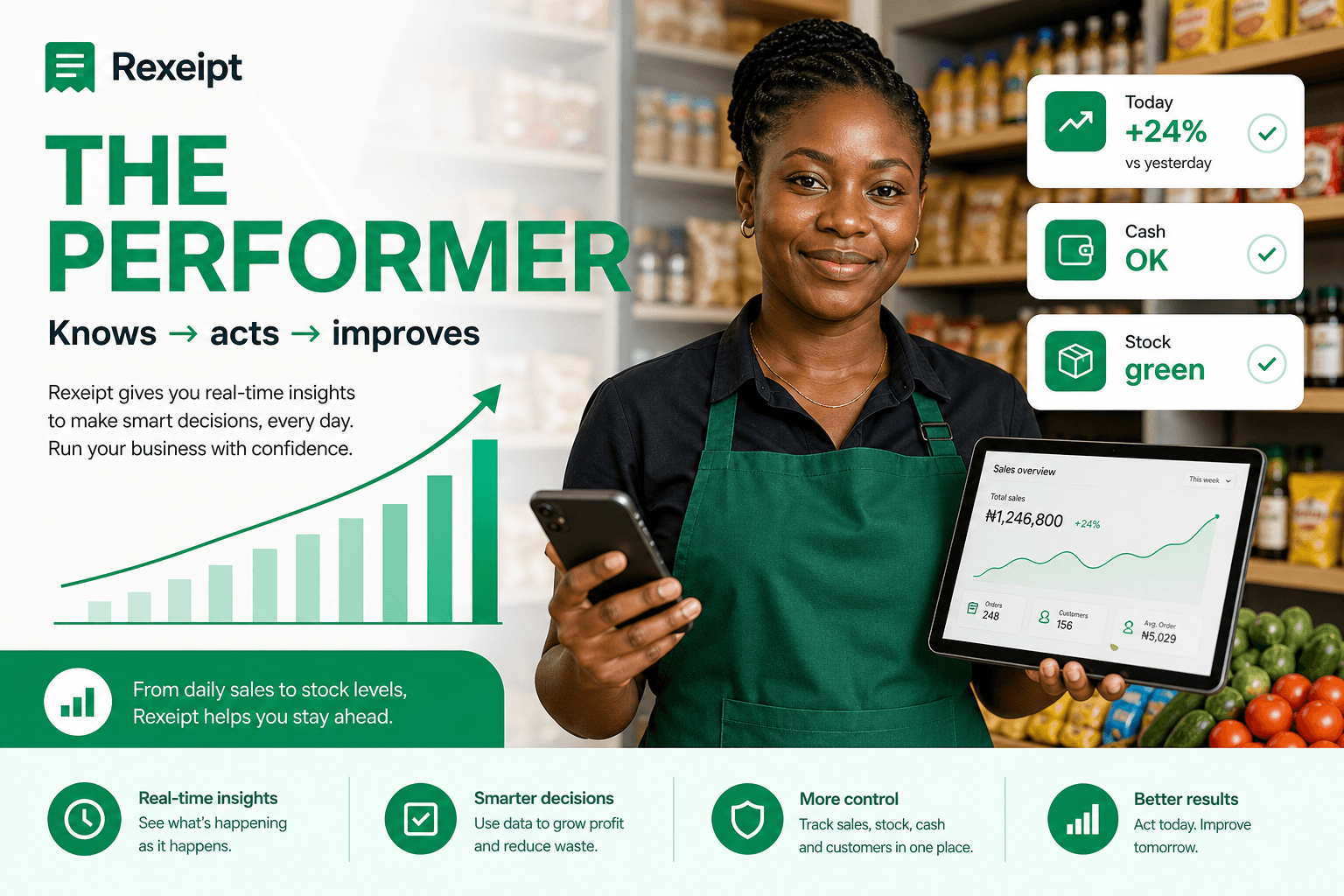
The performerKnows → acts → improves
The performer: clear dashboards, rising trends, and decisive daily habits.

Insight at a glance

Charts trend up because decisions are anchored to fresh numbers — not yesterday's memory.

  • Records sales when it's hectic — portal Record sale or checkout, low friction.
  • Protects cash & credit — balances and IOUs stay visible.
  • Builds feedback loops — measure weekly, tweak pricing & stock early.
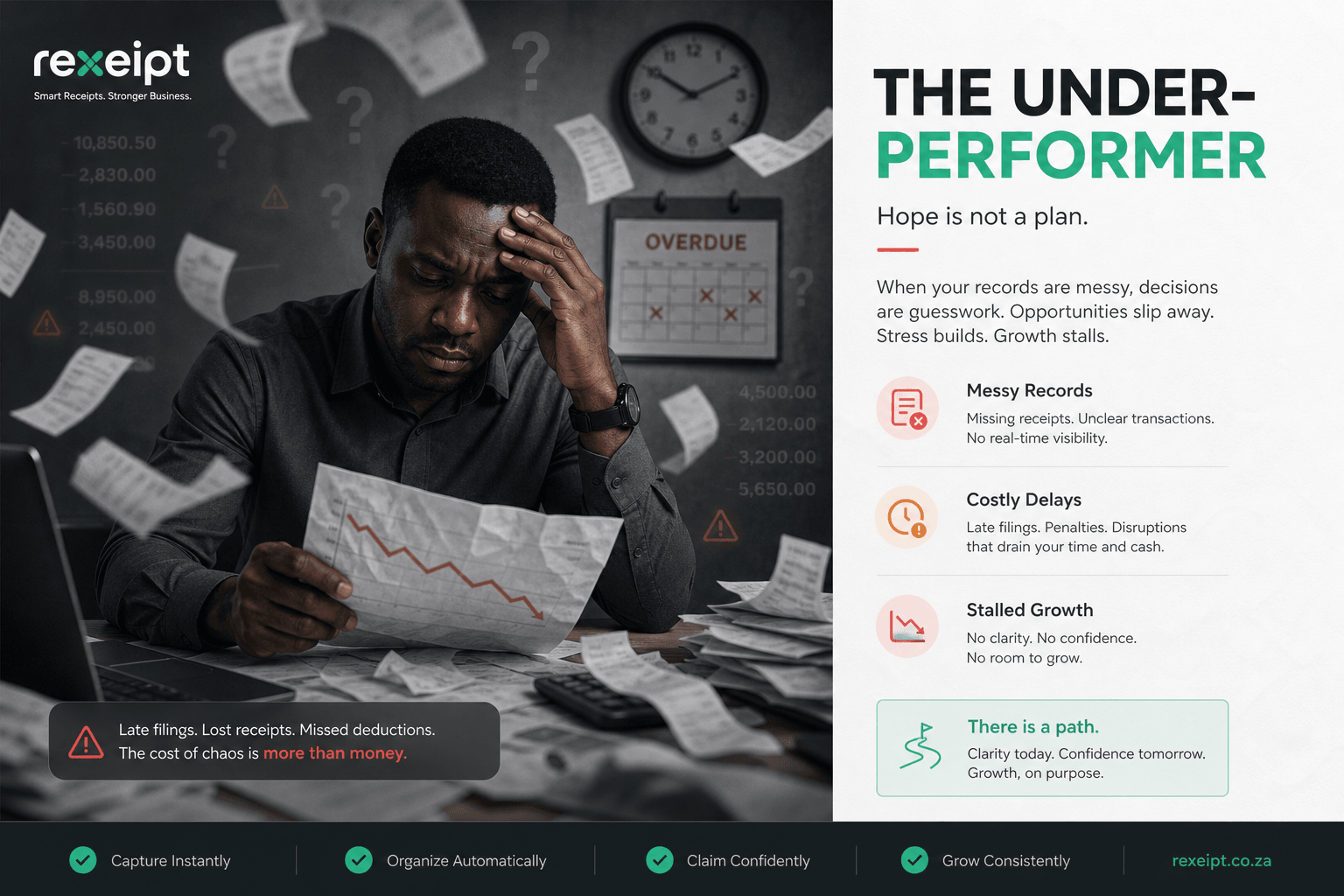
The under-performerHope ≠ planning
The under-performer: scattered records, fuzzy numbers, and slower reactions — fixable with better rhythm.

Data feels fuzzy

Receipts scattered, notebooks incomplete — every guess compounds into slower reactions.

  • "We did okay today" — without reconciling cash & stock.
  • Late on debt & restock — surprises become emergencies.
  • Tools abandoned — too heavy for daily rhythm.

This isn't about blame — busy owners inherit chaos. Better systems create performers.

The five pillars of growth

Every tactic you run — receipts, POS, alerts, summaries — should ladder up to one of these.

1

Pillar 1: Make more money (Revenue)

Make more money

Revenue

More completed, recorded sales — especially in the rush.

2

Pillar 2: Keep more money (Profit)

Keep more money

Profit

Margin awareness beats “busy” revenue. Cut waste, price with data.

3

Pillar 3: Avoid running dry (Cash flow)

Avoid running dry

Cash flow

Know what you have, what’s owed, and what’s coming before you decide.

4

Pillar 4: Keep customers (Retention)

Keep customers

Retention

Trust + proof (receipts) + consistency make people come back.

5

Pillar 5: Operate consistently (Discipline)

Operate consistently

Discipline

Small daily habits beat one big “cleanup” every few months.

What actually distinguishes them

Same pillars — opposite habits.

  • Visibility

    Systemized

    Answers in seconds: what happened, who did it, what is outstanding.

    People-dependent

    Have to call someone. Decisions on mood, not evidence.

  • Staff execution

    Systemized

    Work follows a defined process. Performance is visible.

    People-dependent

    Everyone invents their own way. Quality depends on who is in.

  • Inventory

    Systemized

    Stock, exceptions, and restocks are in the system.

    People-dependent

    Stock lives in someone’s head until a customer is turned away.

  • Customers

    Systemized

    Debts, orders, and experience issues are tracked.

    People-dependent

    Unhappy customers and unpaid balances surface too late.

  • Continuity

    Systemized

    The business keeps running if a key person is away.

    People-dependent

    Operations stall when the person who “knows” is absent.

  • Learning

    Systemized

    Act → measure → adjust → repeat.

    People-dependent

    Act → hope → repeat mistakes.

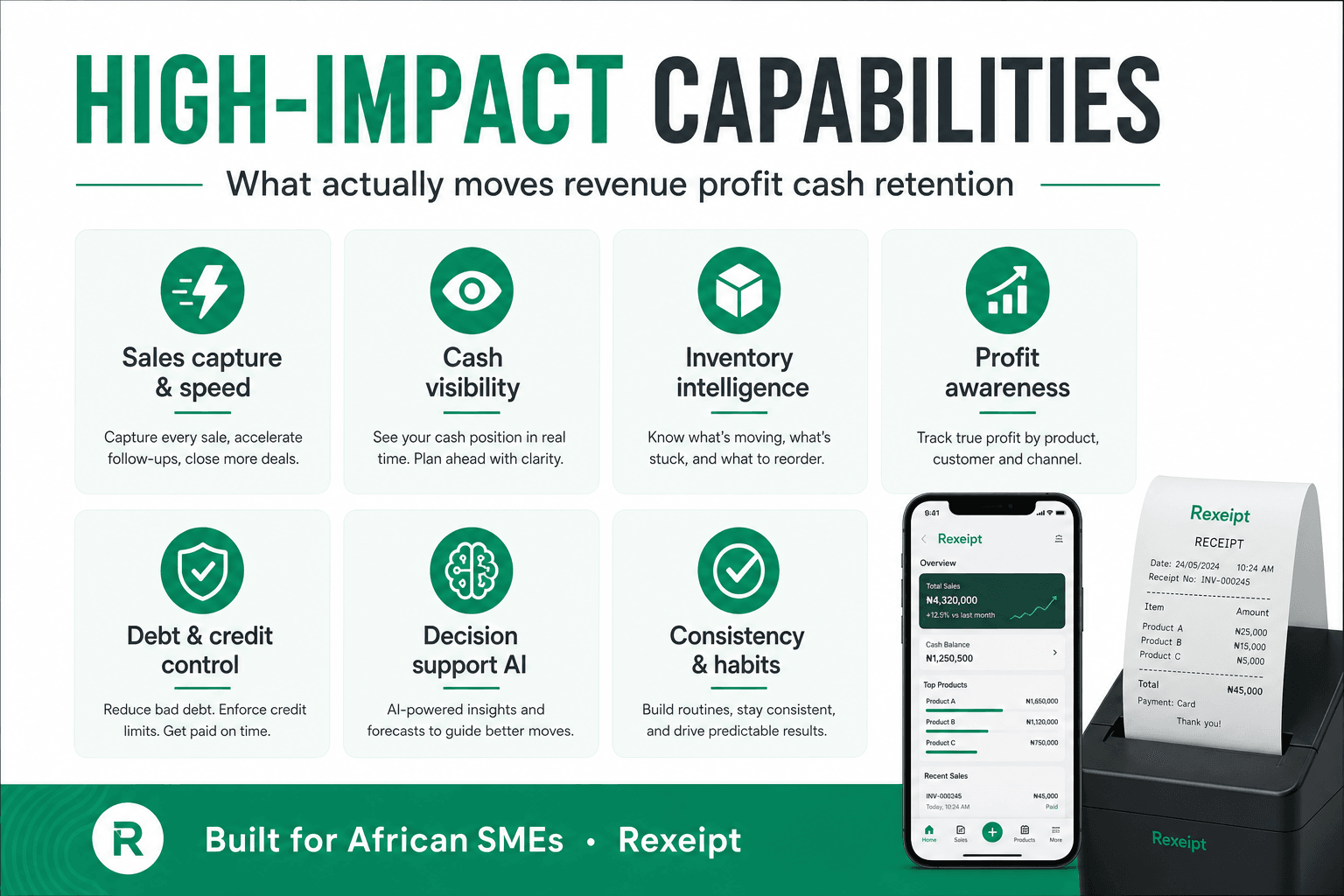
High-impact capabilities that drive growth

Not every feature matters equally — these move revenue, profit, cash, retention, or discipline fastest.

Seven high-impact capabilities: sales capture, cash visibility, inventory, profit awareness, debt control, decision support, and consistency.

Sales capture & speed

Most important
Capability
Fast checkout (web + WhatsApp), voice/chat capture, minimal friction.
Why it grows the business
More honest records, more throughput when it’s busy — growth shows up in the data.
Performer habit
Doesn’t “forget” sales; keeps checkout moving under pressure.

Cash visibility

Survival + growth
Capability
Live positions: cash, bank, platform — inflows vs outflows.
Why it grows the business
Bad timing on spend or stock happens when cash truth is fuzzy.
Performer habit
Always knows balance, obligations, and what’s incoming.

Inventory intelligence

High leverage
Capability
Levels, alerts, production-aware flows, cost awareness.
Why it grows the business
Stockouts lose sales; overstock ties cash that could earn elsewhere.
Performer habit
Rarely surprised by bestsellers going empty or dust collectors piling up.

Profit awareness

Where most slip
Capability
Costs, margins, SKU profitability, rhythm summaries.
Why it grows the business
Revenue without margin discipline grows you into burnout.
Performer habit
Knows winners vs losers on the shelf and adjusts fast.

Debt & credit control

Silent killer
Capability
Customer credit, supplier payables, loans — reminders.
Why it grows the business
Uncontrolled IOUs quietly eat working capital.
Performer habit
Knows who owes; follows up; caps exposure consciously.

Decision support

AI advantage
Capability
Daily summaries, alerts, Copilot-style guidance.
Why it grows the business
Most failures aren’t lack of data — they’re lack of timely decisions.
Performer habit
Acts on signals instead of scrolling past them.

Consistency & habits

Compounds
Capability
Check-ins, reminders, light nudges — daily rhythm.
Why it grows the business
Consistency beats sporadic brilliance.
Performer habit
Shows up for five minutes daily on the books.

Rexeipt closes the gap

Organize information, structure how work gets done, and see what is happening — so the business depends less on memory and particular people.

Start from the homepage — same product, every channel.